One coach hitting fungoes to a line of twelve kids at shortstop is the most common infield practice in America, and the worst one. Each kid fields three grounders in fifteen minutes and watches the other thirty-three. The baseball fielding drills below run in pairs with a bucket of balls, and every kid gets forty.
Half the fair balls in a game are ground balls, so this is most of defense. This is one spoke of the youth baseball drills master list in our coaching baseball hub: the position taught by hand, the partner drills, the plays, the games.
Ready Position and the Last Two Steps
Infield play has a four-word frame: relax, ready, receive, release. Relax between pitches, walk into ready as the pitcher breaks his hands, receive, release. Kids who stand frozen in a crouch for ninety pitches aren’t ready on any of them.
Teach the ready position on a command, not a demonstration. Line them up, say “Ready,” and check every kid by hand: balanced, weight on the balls of the feet, hands by the belt and off the knees. Ages 6 to 10, and you’ll repeat it every April at every age.
Then the fielding position itself, which most kids get wrong in the same way.
- Bend at the knees, not the back. A kid who bends at the back gets his hands under his body and can’t see the ball in.
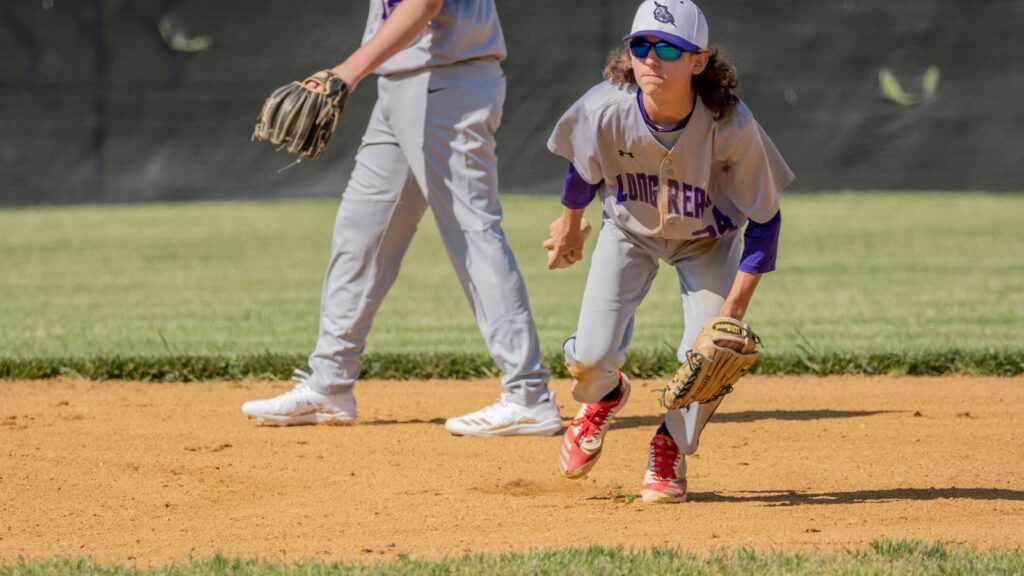
- Arms out in front, back of the glove on the ground, throwing hand above it or beside it.
- Watch the ball into the glove and trap it with the throwing hand. Anyone watching should see the ball disappear.
- Cushion it to the belt with soft hands, feet already turning toward the target. Coaches call that funneling.
The piece nobody teaches is the last two steps. A right-hander finishes right foot, then left, into a wide base behind the ball, which is what puts him low and early instead of stabbing late. For 10 and up, the three-ball pickup builds it with no coach: three balls in a line, walk to each, stop about a foot and a half behind it, two steps, bend the knees, two hands to the chest. Walk it, then jog it. And a rule of thumb that fits ten-year-olds: break down when the ball is about 15 feet away. Later than that and you’re eating in-between hops.
If you fix one thing: a sure, accurate throw beats a rushed hard one, every time, at every age. Fingers down, catch it in the web, get the feet set, point the glove shoulder at the target. The kid who fields it clean and throws it late is one step from being good. The kid who rushes is not.
Partner Baseball Fielding Drills That Multiply Reps (Ages 8 to 12)
Two lines facing each other, one ball per pair, and every kid is fielding or feeding at every moment. A parent who’s never coached can run it.
Partner Ground Balls
Two lines, 25 to 45 feet apart depending on age, partners facing each other. One ball per pair. All the balls start on one side.
- Receivers get into the ready position on your command.
- Feeders roll. Receivers take the last two steps, field, funnel, and throw it back on a line.
- Ten each, then the other line feeds.
Ages 6 and up. Fixes: nothing in particular, which is the point. Pure volume, and the drill to run before a game.
Short Hop
Pairs 12 feet apart. The receiver starts in fielding position with his hands on the ground.
- The feeder tosses underhand, trying to land the ball just in front of the glove for a short hop.
- The receiver catches it before it becomes the in-between hop, the one that comes up higher off the dirt.
- Toss it back the same way. You control when they roll so it doesn’t turn into a throwing contest.
- Vary the speed. Add the feet, arm action, and grip once the hands are reliable.
Ages 8 and up. Fixes: the stab. Kids learn to go get the short hop instead of reaching for the in-between one.
Backhand
Same pairs at 10 feet. A play every infielder makes and almost no team practices.
- On “Roll,” the feeder tosses one step to the partner’s backhand side.
- The receiver starts in ready, pivots toward the ball staying low, and takes a crossover step with the glove-side leg.
- The glove crosses over with that foot, pocket facing the ball, fingers pointed slightly down, a few inches in front of the front foot.
- Bend the knees. The backhand fails when the kid bends at the waist and reaches.
Ages 8 and up. Fixes: the kid who tries to get in front of everything. Some balls are easier on the forehand or backhand than head-on, and the only way he learns which is reps. For 10 and up, combine it with short hops.
Over the Line
Put players at second and short. Draw a line in the dirt 10 to 15 feet in front of them. Roll balls at slow to medium speed.
- As the ball crosses the line, the fielder takes his last two steps into fielding position. Right-left for right-handers.
- Roll until the timing is automatic, then hit them.
- Move the line back if the balls come harder.
Ages 8 and up. Fixes: the kid who bends over at the last second. The line gives him a place to start being low.
Two notes on fear. Tennis balls for line drives and for any kid who pulls his eyes off the ball; hit harder gradually. And for the kid whose glove keeps rising, have him touch the top of the open glove to the dirt before every grounder until it stays down.
Get the printable practice sheets these drills run inside.
A free Fitted Cap God account gets you the 60 and 90 minute practice plans as a one-page PDF, saves the guides you’re using this season, and sends the new ones when they land.
Sign Up FreeThe Plays: First Base, Relays, Double-Play Feeds, Rundowns
These need two or three kids, and they’re for 10 and up. The throw has to be there first; the throwing drills post covers the block and the crow hop.
First Base
The first baseman’s job is catching the ball. Kids worry so much about the foot on the bag that throws get past them. Foot on the base to receive, off it after the catch.
- Low throws: get the body low as soon as the ball looks like it’ll bounce, eyes on it, stretch, glove low to the dirt, bare hand next to the glove to scoop.
- If it can’t be caught, that position blocks it, which is the second-best outcome.
- Target drill: hit a grounder to the first baseman and call the base as the ball arrives. He has to watch it into the glove instead of peeking at where you pointed.
- Score it. Clean field plus on-target throw is a point. Add a third baseman and some bunts when it gets easy.
The Relay
You control the throw, so make it as ugly as you like. The relay man sets up with both hands up, and the stronger arm makes the longer throw.
- Throw to the relay man from the outfield. On a good throw he catches it moving toward his target.
- On a low throw, he backs up and takes it on the big hop, so he has momentum going forward instead of picking it off his shoelaces.
- Relay it in, two new kids fill the spots.
Ages 8 and up. Fixes: the relay man who stands flat-footed and waits.
Shortstop Feeds, Second Baseman Pivots
Set them at double-play depth. You stand beside the mound, in line with home and the shortstop, and roll or lightly hit balls under control.
- Ball to the shortstop’s left. Feed and pivot until it’s clean.
- Ball right at him.
- Ball to his right.
- One location at a time. Don’t mix them until each one is a habit.
Rundowns
The trouble with youth rundowns is judgment, not technique: when to throw, when to call for the ball. That comes from running the play, not explaining it.
- The chaser runs the runner hard. He does not fake a throw, because the fake fools his own receiver.
- The receiver steps to the ball to catch and tag in one motion.
- Set up the scenarios you’ll see in a game and run each one a few times, with the communication out loud.
A tag note for every play: put the glove where the tag will happen and let the ball come to it. The ball is faster than the hand.
Games and the Station Plan
Kids prefer contests. So the drills above become games with a score, and the losing team carries the buckets in.
- Short-hop game. Five kids with a coach, ten short hops each, most catches wins. Or most in a row. The winner leads the stretch at the next practice, and next practice you try to beat the record.
- Reaction game. Same setup, and you throw every kind of ball there is: grounders, liners, ones they have to jump for. Most clean catches in a row. Corner infielders especially.
- Partner ground ball game. Pair them by ability, and the drill becomes a contest without you controlling the tempo.
- Knee drill series for a tired day. Four kids on their knees about 20 feet from your fungo, one-hoppers in order, catch and transfer. Lots of ball handling for almost no energy.
A ground ball is a ground ball. What changes between a bad infield and a good one is how many of them each kid saw in March.
In a station, this is 10 to 12 minutes with four kids: partner ground balls, ten each, then you hit a few. A parent runs the partner half. It slots into the 90 minute template in the practice plan; on a full-team day, kids at every infield spot with throws to first, second, and home.
Frequently Asked Questions
What are some good drills for baseball infielders?
Partner ground balls, short hop, backhand, and over the line, in that order, in pairs. Then the short-hop game and the reaction game so the reps keep coming when they’re bored.
What are the four Rs of fielding?
Relax, ready, receive, release, in sequence on every pitch. You’ll see “five F’s” and “six F’s” of fielding online. The coaching books this site is built on don’t use those lists, so we can’t tell you what they are.
What are good infield drills for 10U?
Short hop, over the line, the three-ball pickup, and shortstop feeds with the second baseman pivoting. All four are in the books’ 10 and up range, and all four are about the feet.
How do you teach a kid to field a ground ball who’s scared of it?
Tennis balls. Roll them, then hit them, then hit them harder, in the partner drills at short distance where he sees a lot of them. Nobody’s ever been talked out of flinching.
Sources
- Drills and Instruction for Coaching Youth Baseball
- Coaching Youth Baseball (American Sport Education Program)
- Coaching Baseball: Technical and Tactical Skills
- Practice Perfect Baseball
- Coaching Baseball For Dummies
- 101 Championship Baseball Drills
Pairs and a bucket beat the fungo line, and it isn’t close. Next up: outfield drills, where the same two-step idea becomes a drop step.