The coaching bible has a story every youth coach should read twice: a coach who spots every flaw in a kid’s swing and tells him all of them, and the kid, who was aggressive with a quick bat, starts thinking and ends up slow. The book’s own line is that coaches have taken .350 hitters and coached them into .250 hitters. So baseball hitting mechanics for a kid come with one rule before any of the mechanics: one at a time. One thought, one fix, one drill, and the rest of the swing left alone until that one holds.
This sits inside the drills master list of our coaching baseball hub. The teaching order for a beginner is in how to teach a kid to hit. This post is for the kid who already swings, and the coach trying to figure out which one thing to fix.
When to Watch, and When to Leave It Alone
The college hitting coach in the coaching bible says not to worry about a kid’s initial setup in the box. Note the hand position and the stance, then watch the whole athlete: is he relaxed, does he move freely, can he see. The moment that matters is when the stride foot hits the ground. That’s where you look, and that’s where the flaws show. Everything before it is style.
The same coach’s warning: some hitters swing where the ball is even though the mechanics look wrong on the way there, and a coach who fixes what isn’t broken makes a worse hitter. Give latitude to anything that keeps the kid relaxed and seeing the ball. Fix the thing that’s producing pop-ups, not the thing that looks unusual.
One check before any mechanics: the eyes. The coaching book that troubleshoots hitters says that when nothing you suggest works, ask the kid to read something across the field. If he can’t, the swing was never the problem, and the parents need to know.
The Mechanics, in the Order They Happen
- Grip in the fingers, bottom hand a little firmer, choked up if the bat is heavy.
- Square stance, feet a bit wider than the shoulders, weight on the balls of the feet, knees flexed, hands five to seven inches off the body at shoulder height, head turned to the pitcher with both eyes.
- Coil as the pitcher’s hand is about to release: front shoulder, hip, and knee turn slightly in, hands go back three or four inches, weight to the back foot.
- Stride: a short step, about six inches, at release, with the weight staying back.
- Front foot plants and the hips lead the bat. Back foot turns on its ball. Belly button ends up facing the pitcher.
- Hands stay back until the hips go, then take the bat on a slightly downward path that levels at contact.
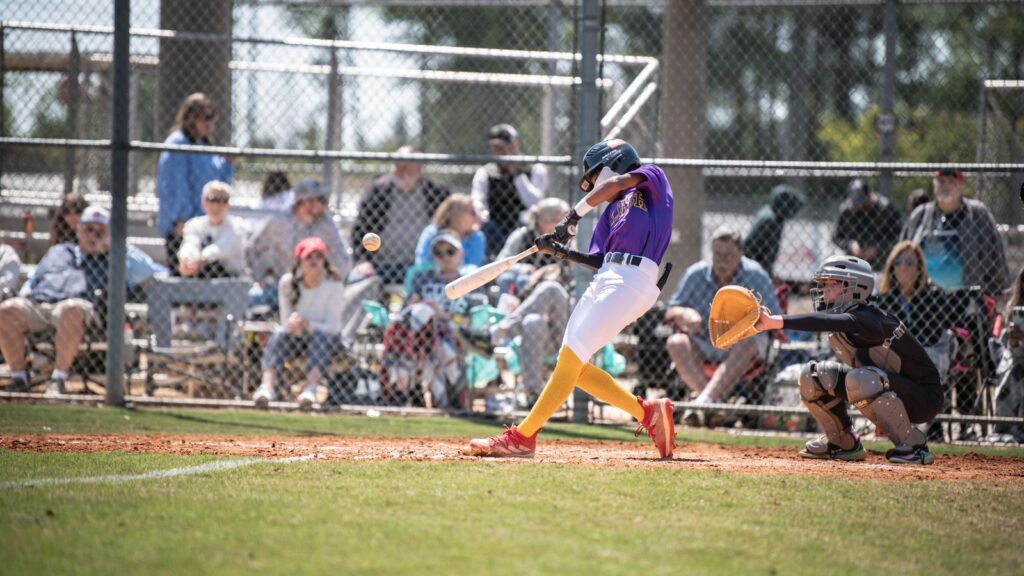
- Contact out in front of the front foot, on the sweet spot, front leg firm, back foot pushing.
- Top hand rolls over after contact and the bat finishes across the body.
Every flaw below is one of those eight going wrong. Find which one, and skip the rest.
Get the printable practice sheets the hitting station runs inside.
A free Fitted Cap God account gets you the 60 and 90 minute practice plans as a PDF, saves the guides you’re using this season, and sends the new ones when they land.
Sign Up FreeThe Flaws, One Fix Each
The Setup Is Wrong
The most common one, and it happens before the pitch. Feet wrong, hands wrong, bat pointed the wrong way. The drills book calls it the biggest problem young hitters have because it produces inconsistency out of nothing. Fix: check the stance before every tee swing until you don’t have to. Physically put him in it.
The Statue
Stiff stance, flat feet, no flex. The drills-and-games glossary has names for both: “statue” and “flat-footed.” A kid standing on his heels can’t move to the ball, and a kid standing straight up is handcuffed on anything low or inside. Fix: weight to the balls of the feet, knees flexed, and a small rhythm in the stance before the pitch so he’s never still.
Lunging (Overstriding)
The weight goes forward with the stride foot and there’s nothing left to swing with. Fix: the stride drill. Lean a bat, head on the ground, against the outside of the back leg. On “Stride,” he strides. If the back leg leaves the bat, the weight went with it. Ages 8 and up, and it works in a hallway.
Stepping in the Bucket
The front foot goes toward third base instead of the pitcher, usually because he’s scared of the ball, and the coaching book says kids who fear the pitch step back before or during the swing. Fix: tennis balls at practice, with a few wild ones to dodge so he learns he can get out of the way, then work up to baseballs. And in soft toss, feed inside and out front so he gets the bat around and drives a few to the pull side; confidence fixes the front foot faster than a cone does.
The Uppercut
Barrel drops, swing loops up, pop-ups and swings under everything. The drills book says it’s common and the college drills book calls it the loop. Fix: two tees in a line 12 to 18 inches apart, ball on the front one. If he clips the back tee, the barrel dropped. Cue: keep the head of the bat up as long as possible. Ten in a row clean before you move on.
Casting and the Chicken Wing
The front arm lifts out and the hands drift away from the body, a long slow swing that arrives late. Fix: isolate the upper half with one hand. The knee drill from the college book: kneel on the back knee, one hand on a tee-ball bat, feeder tosses to the inside knee, the belt, or the back leg. Or the top-hand swing: very small bat, choked up, bottom hand on the hip, soft toss, line drives only. A one-handed swing can’t cast.
The Head Moves
The coaching bible’s fix is the best in the books because it’s in the legs, not the head. If the head pops up on the stride, straighten the knees until it stays still. If the head drops, flex the knees deeper. If it rocks front to back through the stride, the fix is in the abdominals and lower back. Video helps here: once a kid sees his head move, he can feel it. And the tennis-ball target with a dot on the ball keeps the eyes down through contact.
The Hitch
The hands drop or pump before the swing, so the bat is late. The coaching book’s step one of the swing is that the head is still and the bat stays steady during the windup. Fix: the four-count dry drill (stance, coil, stride, swing), freezing at each number, so he feels the hands go back with the coil and nowhere else.
No Finish
The bat stops at contact. Fix: the T-ball target. A tennis ball on the tee, a parent with a glove 15 yards out; the kid tries to hit the target. The coaching book says the follow-through it teaches is essential for both power and consistency, which is why the drill is for six-year-olds and also for the 11-year-old who’s cutting his swing off.
Admiring the Hit
Not a swing flaw, but it costs more bases than any of them. The kid pauses in the box to watch it. Fix: run through first on every ball at practice, and praise the sprint louder than the hit.
The Cues That Work
- “Squash the bug.” The back foot turns on its ball and the hips come with it. The coaching book’s cue and every kid gets it.
- “Down and hard.” Line drives and hard ground balls; the Little League games book’s mantra for young hitters, and the cure for the kid who’s trying to hit it out.
- “Shoulder to shoulder.” Chin on the front shoulder at the start, on the back shoulder at the finish, so the head stays in.
- Say what to do, not what not to do. “Hands back” beats “don’t hitch.” The USA Baseball manual’s rule for every correction.
- One thought per at-bat. The coaching bible wants a hitter to carry a single mechanical thought into the box, and it wants him to erase the last pitch with a short ritual before the next one, because the average athlete’s visual memory of the last pitch lasts about 13 seconds and that’s long enough to ruin the swing.
A kid with one thought swings. A kid with three thinks. The coach decides which one walks to the plate.
Frequently Asked Questions
What are the basic hitting mechanics for youth baseball?
Grip in the fingers, a square balanced stance, a small coil and a short stride with the weight back, hips leading the hands, a slightly downward bat path that levels at contact out in front of the front foot, and a full follow-through. Teach them in that order, one at a time.
How do you fix an uppercut in a young hitter?
Two tees in a line, ball on the front one, and the back tee stays untouched. If the bat clips it the barrel dropped. The cue is to keep the bat head up as long as possible, and the count is ten clean in a row.
Why does my kid step away from the plate?
Fear of the ball, almost always. Tennis balls, a few wild ones to dodge, inside tosses he can drive, and then baseballs again. The front foot follows the confidence.
Should I change my kid’s stance?
Probably not. The college hitting coach in the coaching bible says to leave the setup alone and watch what happens when the stride foot lands. If the kid is relaxed, sees the ball, and hits line drives, an unusual stance is a style. If he’s popping up, the fix is one of the flaws above, not the stance.
Sources
- The Baseball Coaching Bible
- Coaching Baseball For Dummies
- Drills and Instruction for Coaching Youth Baseball
- 101 Championship Baseball Drills
- Coaching Youth Baseball (American Sport Education Program)
- Making Little League Baseball More Fun for Kids
- Baseball and Softball Drills: More Than 200 Games and Activities
Watch the stride foot land, pick the one flaw that’s costing him, run its drill until it’s gone, and say nothing about the other seven. Next: the tee drills, which are where most of these fixes actually get done, and the batting drills for the full progression.