A batting tee looks like the beginner’s tool and it’s the opposite. A big-league hitter quoted in the drills book says the most important work he does is still on a tee, because it slows the swing down enough to fix one thing. That’s the whole value: each of these baseball tee drills isolates one flaw. Set the tee for the flaw, swing until it’s gone, move to the next one. A kid who hits fifty balls off a tee set in the same spot every day has practiced one swing fifty times, which is fine if it’s the right swing and a problem if it isn’t.
This sits inside the drills master list of our coaching baseball hub. The teaching order for a beginner is in how to teach a kid to hit, and the full progression from tee to live is in the batting drills post. This one is only the tee.
Setting the Tee, Which Is Most of the Drill
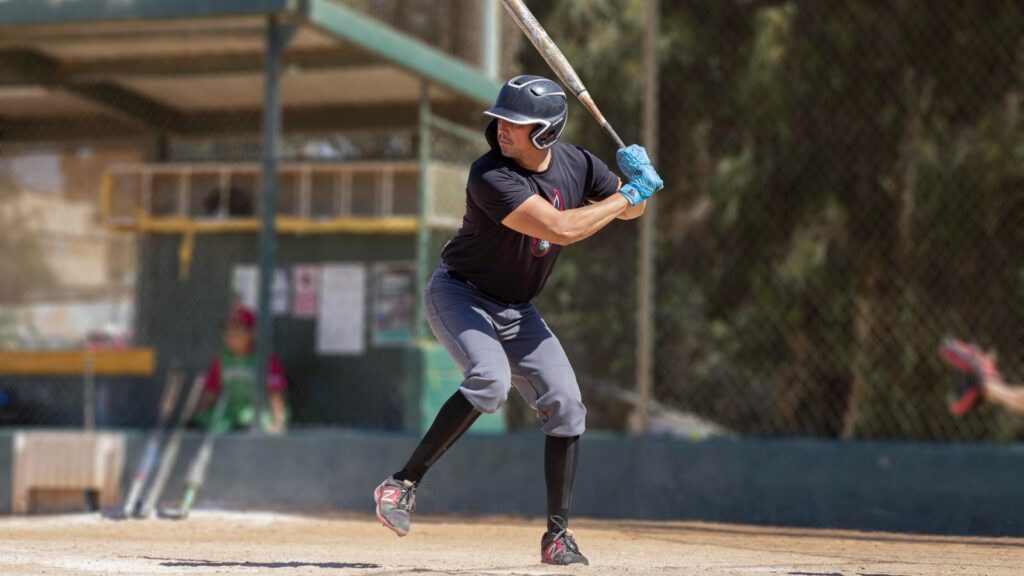
Two setups from two books, and they agree. The drills book: stem at the hitter’s mid-thigh, lead foot just behind the stem, ball out in front of the body. To find the distance, have the kid take his stance and stop a swing at the contact point, hands not fully extended, ball on the sweet spot of the barrel. That’s where the tee goes.
The coaching bible’s version starts from the front foot instead of the plate. Have the kid take a full swing and watch where his front foot lands and pivots; ignore home plate. The ball for an outside pitch goes directly in front of that front foot, in line with the outside corner. Then, on a 45-degree line toward the pitcher, the middle-of-the-plate ball, and farther along the same line, the inside ball. Each one sits about a half inch higher than the one outside it, because the barrel rises that much from outside contact to inside contact. The rule under all of it: meet the ball in front of the striding foot. Behind it, you get a ground ball to the opposite field every time.
If the tee is in the wrong place, every drill below teaches the wrong swing. Set it from the front foot and the contact point, not from home plate, and reset it when the kid’s stance changes.
The Drills, One Flaw Each
1. Line Drive Count
Tee set for a pitch down the middle. The kid hits the ball straight into the net at stem height and counts how many line drives in a row. A pop-up or a grounder resets the count.
- Set the tee at mid-thigh, front foot behind the stem, ball out front.
- Swing for the net at the height of the tee. Not up, not down.
- Count consecutive line drives. Beat the number next time.
Ages 6 and up. Fixes: nothing specific, which is the point. It builds the swing the other drills adjust, and the drills book calls a line drive back up the middle the best place to hit a baseball.
2. Two Tees, Forward and Down
Two tees in a straight line, 12 to 18 inches apart, stems at the same height, ball on the front tee only. Or one tee with a bucket behind it and a small cone on top of the bucket at the same height.
- Hit the ball off the front tee without touching the back tee or the cone.
- If the bat clips the back one, the barrel dropped or the swing looped up.
- Repeat until ten in a row clear it.
Ages 7 and up. Fixes: the uppercut, which the drills book says is the most common youth swing flaw. The college drills book runs the same drill with the back tee higher or lower than the front, calls it “straight to the ball,” and adds the cue: keep the head of the bat up as long as possible.
3. Three-Zone Single Tee
One tee, moved. The kid straddles the plate in his stance and “measures up” by reaching out and touching the far side of the plate with the bat. Then the tee goes to one of three spots: in front of the plate on the inside corner for an inside pitch, just off the back outside corner for an outside pitch, directly in front of the plate for the middle.
- Ten swings outside. Ball goes to the opposite field.
- Ten swings middle. Ball goes back up the middle.
- Five swings inside. Ball goes to the pull side, and the barrel gets out front.
Ages 9 and up. Fixes: the kid who swings the same at everything. The college book’s note is that pitchers work hitters away, so the outside tee gets most of the reps. At the youth level that’s also true of the coach who can’t throw a strike inside.
Get the printable practice sheets the tee station runs inside.
A free Fitted Cap God account gets you the 60 and 90 minute practice plans as a PDF, saves the guides you’re using this season, and sends the new ones when they land.
Sign Up Free4. Double Tee on Command
Two tees with a ball on each: one on the front outside corner of the plate, one on the inside corner six to eight inches in front of it. The coach or a partner calls “inside” or “outside” as the hitter loads.
- Stance, load.
- Hear the call, hit that ball, don’t touch the other.
- Reload both tees every rep. Most calls are “outside.”
Ages 10 and up. Fixes: the hitter who decides where the ball is going before the pitch. It adds a decision to the tee, which is the one thing a tee can’t otherwise do.
5. Triple Tee for Power
The coaching bible drill, with three tees (or one tee moved three times) placed as described in the setup section: outside ball in front of the front foot, middle and inside balls along the 45-degree line toward the pitcher, each a half inch higher than the last.
- A set of swings at the outside ball, then the middle, then the inside.
- Then a ball on the outside tee and one on the inside tee at once; hit the inside one.
- Watch: kids hit the outside ball and miss the inside one until the swing is right.
Ages 10 and up. Fixes: contact behind the front foot, which kills power. The theory in the book is “from the top, out in front, up the middle”: the bat comes down on the ball, contact is in front of the striding foot, and the hitter aims at the pitcher instead of trying to pull.
6. Top-Hand Tee
A very small bat for the kid’s size, choked up. Normal stance with two hands, then the bottom hand comes off and goes on the hip.
- Swing one-handed with the top hand only, off the tee or in soft toss.
- Line drives only. A one-handed pop-up means the hand rolled early.
- Ten reps, then back to two hands and feel the difference.
Ages 10 and up. Fixes: a lazy top hand. The drills book prefers it in soft toss but it works on the tee first. The college book’s knee drill is the cousin: kneel on the back knee, one hand on a tee-ball bat, feeder tosses to the inside knee, the belt, or the back leg.
The Tee Game
The college practice book turns the tee into a test. A grid in front of the plate marks the impact area and the ball-flight pattern, and a scoring mat with point values hangs on the net. Each hitter gets a set number of swings and a score. Repeat the test every two weeks in the preseason and once a month in season; the number is a motivator and it tells the coach who’s improving. For a youth team, tape three zones on the net (low line drive, middle, high) with three, two, and one points, and keep the sheet.
The tee is boring for exactly as long as nobody is keeping score.
Running a Tee Station
The drills book’s station: two tees, two players at each, ten swings per turn, and the player who isn’t hitting picks up the ball and reloads the tee wearing a helmet. Rotations run about 15 minutes with time built in to move. Before the stations, the same book runs ten to fifteen reps each of the dry hitting drills, at every hitting practice: grip, stance, stride to balance, squish the bug with the back foot, step and pivot, hands forward and down on the approach, shoulder to shoulder with the head still, and full swings finishing balanced. Then the tee. Then soft toss. Whiffle balls off the tee for the little ones mean nobody chases, and indoors a tee into a net is the whole hitting plan.
Where the Tee Goes Wrong
- Tee too far back. Contact behind the front foot, opposite-field grounders, no power. Reset from the front foot.
- Hitting the tee. The barrel is under the ball; the swing plane is up. Drill 2.
- No purpose. The college practice book’s rule for any piece of equipment is that it works only when the athlete uses it for a specific skill. A tee with no flaw assigned is a bucket of reps of whatever he already does.
- Fifty swings. The practice plans use ten per turn, twenty per station. After that the swing gets sloppy and the reps count against you.
Frequently Asked Questions
Are tee drills good for power?
Yes, and the coaching bible’s tee drill was designed for exactly that: contact in front of the striding foot with the sweet spot of the bat, to all three zones with the same swing. Power is where the ball meets the barrel, and the tee is the only place you can put the ball there fifty times in a row.
How many tee swings should a kid take?
Ten per turn at a station, about twenty per practice, plus whatever he does at home while the swing is still sharp. The count matters less than the flaw: ten swings at one fix beats fifty at nothing.
What height should a batting tee be?
Mid-thigh for a pitch down the middle, and about a half inch higher for each zone as the ball moves inside, because the barrel rises through the zone. Adjust it every time a different kid steps in.
Do big-league hitters really use a tee?
The drills book quotes one saying the tee and soft toss are still his most important work because they slow everything down. The coaching bible’s author admits he thought the tee was a warm-up toy until a big-league hitting coach showed him otherwise.
Sources
- 101 Championship Baseball Drills
- The Baseball Coaching Bible
- Drills and Instruction for Coaching Youth Baseball
- Practice Perfect Baseball
- Coaching Baseball For Dummies
Set the tee from the front foot, give every set of swings a flaw to fix, and keep a score on the net. Next: hitting mechanics, one fix at a time, which is the list of flaws these drills are for, and the indoor practice plan where the tee does most of the work.